
Bleach Spots: Identification and Colour Repair Guide
Last Updated: January 2026
Editor's Note: This article was originally published as an industry guide to identifying chemical colour loss. If you have discovered a bleach spot on your carpet and are looking for an immediate solution, please note: Bleach spots are permanent colour damage, not stains. They cannot be "cleaned" away; the colour must be restored.
-
Need professional help? Visit our Carpet Dyeing & Bleach Repair Services page to get a quote.
-
Are you a cleaner looking to learn this skill? Check our Training Courses.
December 14, 2022
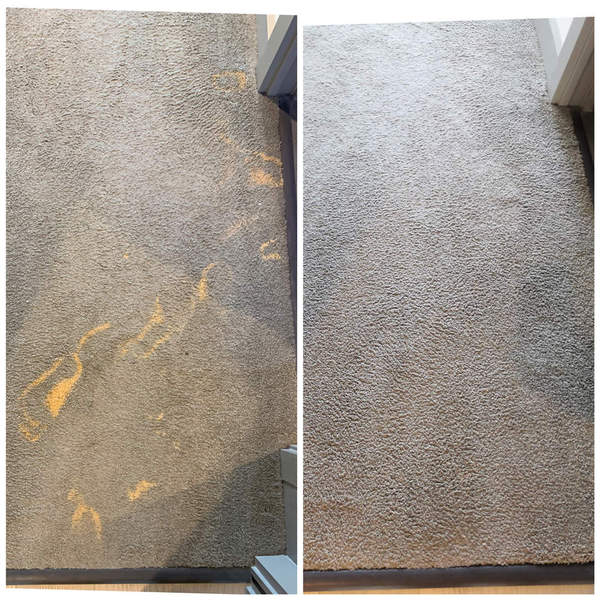

We usually refer to colour loss on carpets and rugs as bleach spots, whether they are caused by actual household bleach (sodium hypochlorite) or any other bleaching agent.
The stains caused by sodium hypochlorite are easy to identify, as most are typically yellow: bleach removes the blue and red dyes, leaving the yellow behind.
For those who do colour repair, this basically means that any sodium hypochlorite bleach stain can be corrected by adding the missing purple (a mix of red and blue).
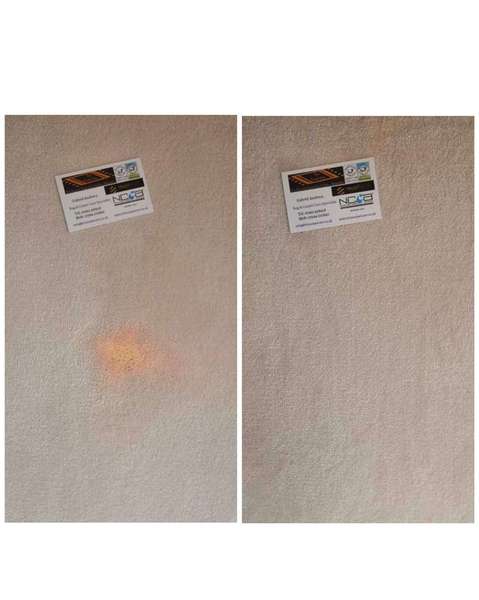
Other bleaching agents like benzoyl peroxide remove mainly the blue, leaving behind the dreaded pink stains (red and yellow make orange / pink).
For the last few years I've corrected many of these BPO pink spots, mainly for high end property developers who were unlucky enough to fit nylon 6.6 carpets before doing final touches on skirting boards, cupboards or doors repaired with two part wood fillers.
The hardener part in the two part wood fillers is benzoyl peroxide based, so any sanding effectively creates bleach dust.
Once the dust finds its way onto the carpet and the conditions are right (humidity + heat) it bleaches the fibres.
In my tests for a major carpet manufacturer, nylon 6.6 was the most susceptible to colour loss caused by BPO.
To make things even more complicated, unlike hydrogen peroxide, benzoyl peroxide is not self neutralising so any BPO dust left for example on skirtboards or windowsills could potentially cause carpet colour loss days or even weeks after the wood sanding was done.
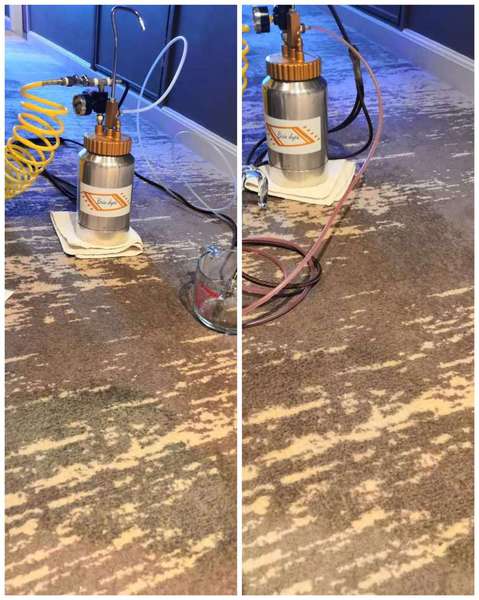
But if we look at the “acid bleach spot” picture, the spot is neither yellow nor pink, it's green!
As a carpet cleaner one might have noticed the greenish stains caused by using too much rust remover while trying to remove a rust stain or, as in the case of one of our customers, some of the hard floor cleaning solutions – they are both highly acidic.
Strong acids can remove the red colour (hence the green stain, as the remaining blue and yellow make green).
The stain pictured is one of the many we've corrected for a well known high end hotel chain and following rigorous testing we've managed to trace it down to their highly acidic descaler.
They've since introduced new measures and trained their staff accordingly, to prevent further carpet bleaching.
If you'd like to learn more about bleach spots and how to correct them, join us for the Carpet Dyeing and Colour Repair course on the 28th of February 2023 at Ecoclean Rugs in Cheltenham, Gloucestershire.
Gabriel Andreca
Brio Carpet Care
Author’s Update: The Science of Colour Correction
Since writing this article, we have seen a surge in queries about mysterious spots appearing on carpets. Understanding the chemistry is the first step to fixing them. Here is a deeper breakdown of what is happening to your floor:
1. Why is my carpet pink or orange? (Benzoyl Peroxide)
As mentioned in the article, this is common in households with teenagers (acne medication) or recently renovated homes (wood filler dust).
-
The Chemistry: Benzoyl Peroxide is stealthy. It lays dormant in the fibres until humidity or heat (like steam cleaning) activates it.
-
The Fix: You cannot scrub this out. The blue dye molecule has been destroyed. To fix this, we use Brio Dyes to chemically neutralize the bleach and then surgically replace the missing blue pigments to restore the original beige or grey tone.
2. Why is the spot yellow? (Chlorine Bleach)
Household bleach (Sodium Hypochlorite) is the most aggressive. It strips Blue and Red dyes almost instantly, leaving only Yellow.
-
DIY Warning: Many homeowners try to dye these spots with tea, coffee, or markers. Please avoid this! These substances are not colorfast and will often result in a dark, muddy patch that is harder to fix than the original yellow spot. Professional colour repair uses acid dyes that bond permanently to the nylon or wool fibre.
3. Why is the spot green? (Acid Damage)
Often seen in hotels or bathrooms, this is usually caused by toilet bowl cleaners or descalers.
-
The Reaction: Strong acids strip the Red dye, leaving Blue and Yellow (which looks Green).
-
The Solution: We have to neutralize the pH of the carpet first; otherwise, any new dye we add will be unstable. Once neutralized, we restore the red tones.
Can all bleach spots be repaired?
In 99% of cases, yes. Whether it is a small splatter or a large handprint, provided the carpet fibre itself hasn't been structurally damaged, colour repair is a viable, invisible, and cost-effective alternative to replacing the whole carpet.
Do you have a mystery spot? Send us a message via our Contact Page for a diagnosis.
 Print
Sitemap
Print
Sitemap
Call Us Now
Tel: 07564010847
Email: info@briocarpetcare.co.uk
Copyright © 2011-2025 Brio Carpet Care. All rights reserved.